The BBC Sound Effects Archive: How To Use It, And Where The Licence Stops
Sound is the part of a video people notice only when it is missing. A shot of a forest is a shot of a forest; the same shot with insects in the distance, a bird two layers back and wind moving through the canopy is somewhere you have been. That difference is almost entirely sound design, and it costs nothing to add except knowing where to get the files.
The BBC has published its sound effects archive online: over 33,000 recordings gathered in the field across decades, free to download without an account. It is one of the best resources a documentary-style channel can have. It also comes with a licence restriction that a lot of the people sharing it leave out, and that omission is the expensive part.
So this is the whole thing: what is in the archive, how to work it quickly, exactly where the licence stops, and what to use instead once your channel is monetised.
What is actually in there
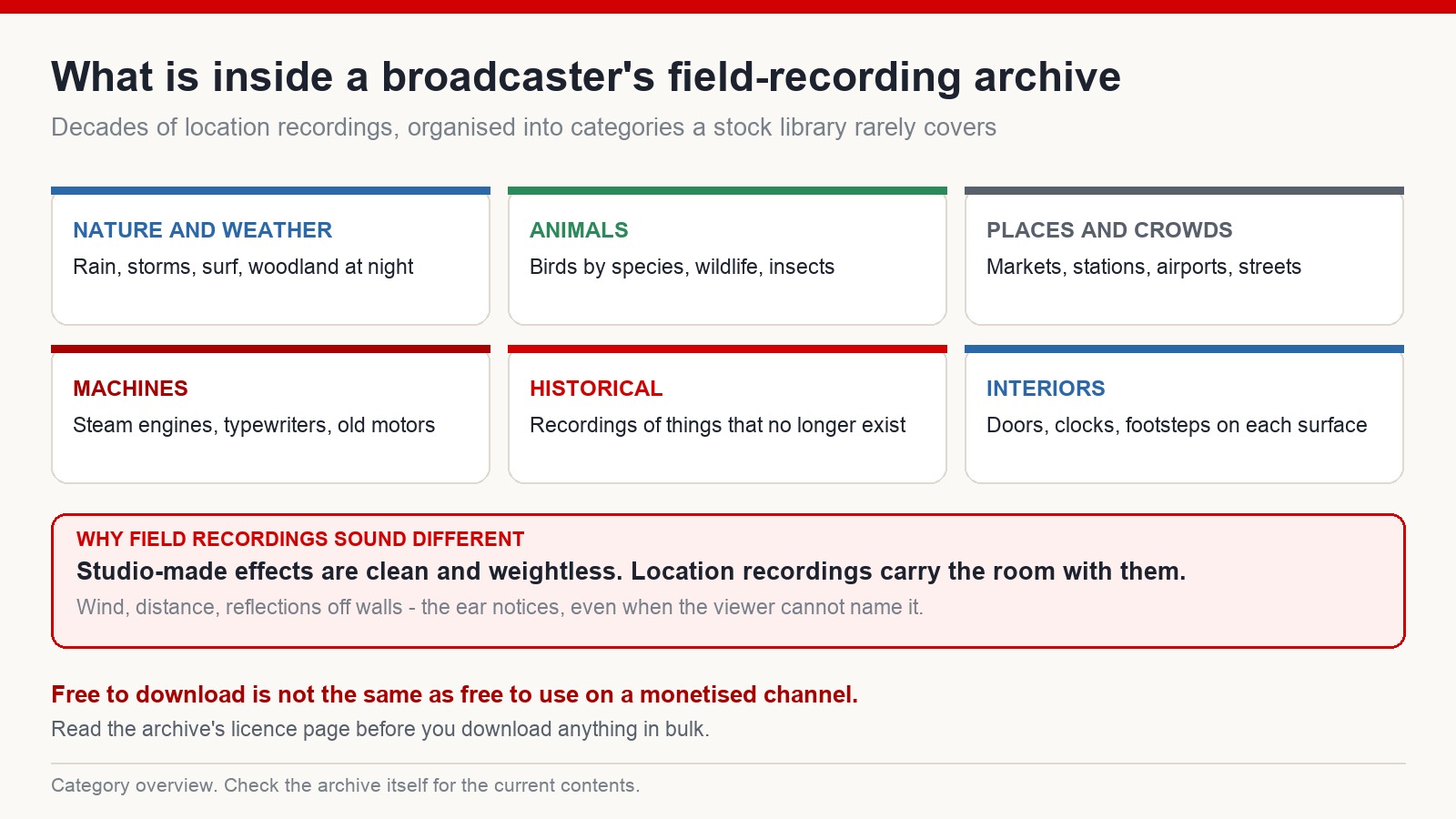
The archive lives at sound-effects.bbcrewind.co.uk, and the collection is broad rather than deep in any one direction:
- Nature and weather – rain of different intensities, thunder, surf, woodland at night, wind through different kinds of vegetation.
- Animals – birds catalogued by species, wildlife, insects, farm animals.
- Places and crowds – markets, railway stations, airports, restaurants, streets in different cities.
- Machines and vehicles – steam engines, typewriters, older motors, industrial equipment.
- Historical recordings – material going back to the mid-twentieth century, including the sound of things that no longer exist.
- Interiors – doors, clocks, footsteps on wood, gravel, tile, carpet.
The depth is what makes it unusual. Some of these recordings could not be made again at any price: a bird that has become rare, a machine that was scrapped, the ambience of a market as it sounded decades ago. For anyone making history, nature or storytelling content, that is material money cannot easily buy elsewhere.
Four things that set it apart from a normal stock library
- No account. No sign-up, no email capture. You listen, you click, you have the file.
- Original-quality WAV files rather than re-compressed MP3s.
- Real descriptions on each entry – what it is, where it was recorded, what was happening.
- A mixer built into the site, so you can layer several recordings, balance them and download the blend.
Documentary editors like field recordings for a specific reason. Most stock effects libraries are full of material built in a studio: clean, isolated, and oddly weightless. A location recording brings the space with it – the wind, the distance, the reflections off nearby surfaces. Viewers cannot name what they are hearing, but they register it as real.
Working the archive in two minutes
Search in plain, specific English. The catalogue matches on descriptive terms, so “rain on tent” returns something quite different from “rain”. Specific beats poetic every time.
Listen before you download. Each entry has a play button and a waveform. Read the waveform: an even band is ambience you can loop under a scene; sharp spikes are individual events you will cut to. Read the description too, because a four-minute file often contains the ten seconds you actually want.
Filter. Category, duration and geographic filters cut a search of hundreds down to a handful worth auditioning.
Build a personal library once, use it forever
The habit that saves the most time: spend one session pulling thirty to fifty sounds that suit your niche, rename them in words you will actually search for, and file them in one folder. After that, every video is a drag and drop rather than a search.
It also does something for the channel itself. Using the same handful of ambiences and transition sounds across your videos builds a recognisable sonic texture, the same way a consistent narrator voice does. Regular viewers notice, even if they never articulate it.
A starter list for a nature or documentary channel, as search terms: forest ambience, wind trees, rain heavy, rain light, thunder distant, stream small, waves shore, fire crackle, birds dawn, owl, insects night, footsteps gravel, footsteps wood, door creak, clock tick, church bell, train steam, engine idle, market crowd, cafe interior, station announcement, paper rustle, typewriter, camera shutter, keys, glass, wind howl, boat water, church interior, night ambience.
The part most people leave out
This is the important section, and the reason people get caught.
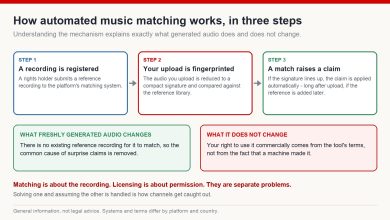
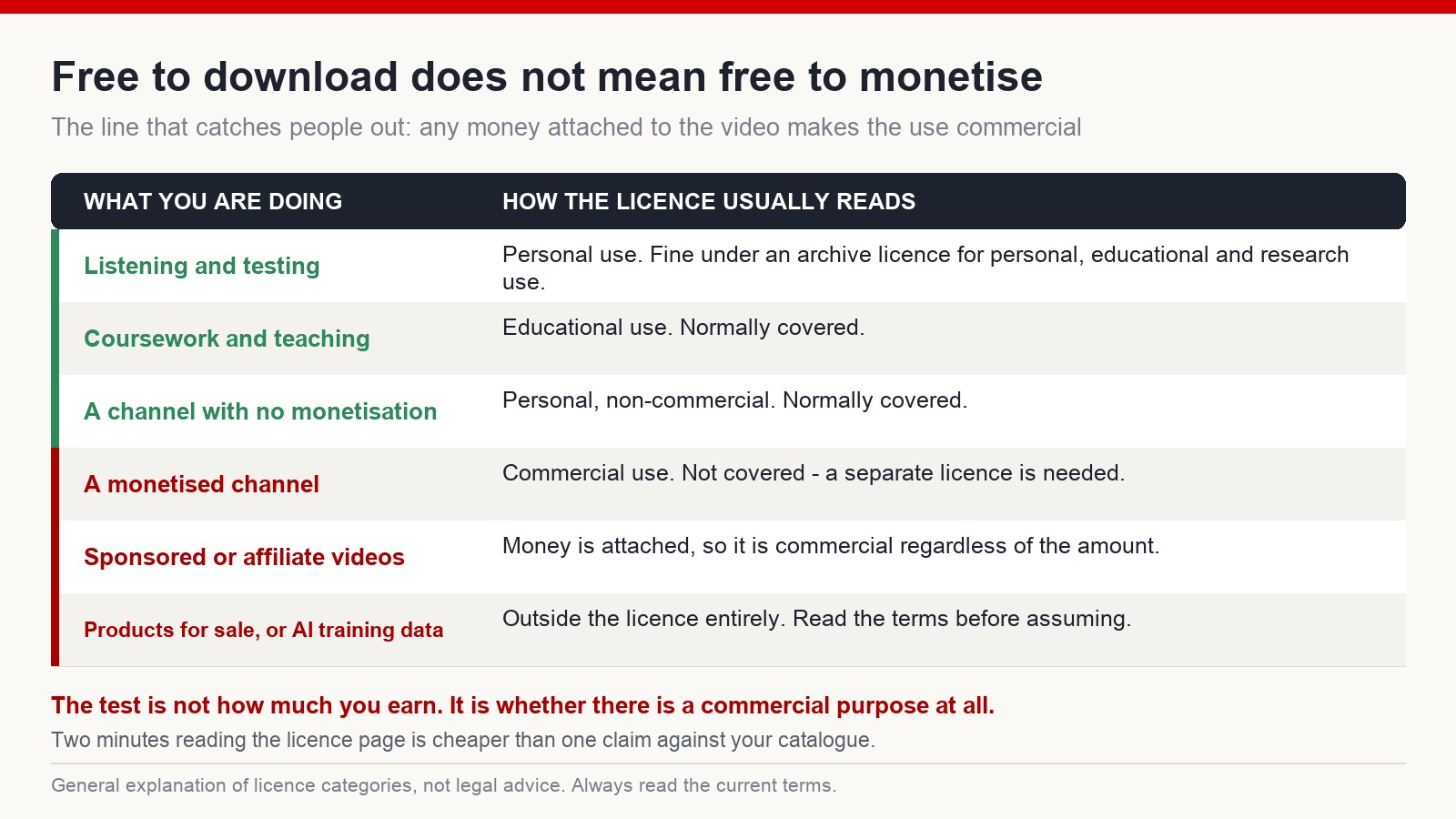
Plenty of posts share this archive with the words “100% free” attached. That is not accurate. The recordings are released under a licence for personal, educational and research use. A monetised video is commercial use. Commercial use is not covered, and requires a separate licence from the rights holder.
The definition worth memorising: if there is money attached to the video, it is commercial. Advertising revenue counts. A sponsorship counts. An affiliate link counts. The test is not how much you earn – it is whether there is a commercial purpose at all. “My channel is small, it will be fine” is not a licence position, it is a hope.
So the honest reading is: excellent for learning sound design, for a personal project, for coursework, for a channel that is not monetised. Not for a channel running ads.
What actually happens if you get it wrong
Nobody arrives at your door the next morning. That is precisely what makes it dangerous – the consequence is delayed, and it lands at the worst moment.
A copyright claim can redirect the revenue of a video to whoever filed it. Repeated formal complaints can end a channel and take the associated account with it. Worst of all, a sourcing mistake can sit quietly for months while you build a library on top of it, and only surface when the channel starts getting attention – at which point the same bad habit is spread across dozens of uploads.
The pattern is consistent: channels are rarely killed by a shortage of resources. They are killed by using resources under the wrong licence.
Four alternatives for a monetised channel
If your channel carries advertising, take your audio from these instead, listed by how little can go wrong:
- The platform’s own audio library, inside your creator studio. The safest option, because licensing is already handled and the content-matching system is not going to flag it. The catalogue is smaller and gets used by everyone, so expect some overlap with other channels.
- Pixabay Audio – commercial use permitted, no attribution required, large and quick to search. Quality is uneven, so audition properly.
- Mixkit – commercial use permitted under its licence, well organised, strong on editing effects. Smaller library.
- Freesound – an enormous community archive, but the licence is set per file. Use the filter and take CC0 material. Files under an attribution licence are usable if you credit them exactly as required. This is the easiest of the four to get wrong.
A simple policy for anyone starting out: default to the platform’s own library for every monetised video, and only go elsewhere when you need a specific effect it does not have. Fewer sources means fewer licences to keep track of, and far less chance of forgetting where a file came from.
The two-minute rule for any source
Before downloading in bulk from any site, do three things. Open its licence page. Search that page for the word “commercial”. Screenshot the terms with the date visible.
If a dispute ever arrives, you have evidence of what the terms said when you downloaded. Two minutes of reading is considerably cheaper than losing a video – or a channel – to a licence you assumed rather than checked.
Frequently asked questions
Is the BBC sound effects archive really free?
Free to access and download, yes. Free for any purpose, no. The licence covers personal, educational and research use. Commercial use, which includes monetised video, needs separate permission.
Does a small channel with few views count as commercial?
If advertising, sponsorship or affiliate revenue is attached to the video, the use is commercial regardless of scale. The licence draws its line at purpose, not at income.
Can I use the archive while my channel is not yet monetised, then leave the files in?
That is the trap. The videos stay online after monetisation is switched on, and the use becomes commercial at that point. If you plan to monetise eventually, source from commercially licensed libraries from the start.
What is the safest source overall?
The audio library built into your creator studio. It is smaller and less distinctive, but the licensing is settled and it will not produce a surprise a year from now.
The short version
A field recording archive of this size is a genuine gift to anyone learning sound design, and layering real ambience under your footage is one of the cheapest upgrades available to a small channel. Use it to learn, use it on personal projects, use it in teaching.
Then, the moment there is money attached to a video, switch sources – and keep a screenshot of every licence page you rely on. If you want a structured route through building a channel properly, including the boring parts like this one, the training system at mmoyoutube.com works through it step by step. Nothing here is legal advice, and licence terms change: read the current page yourself before you download.